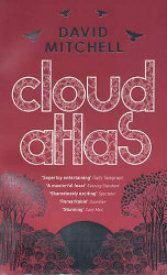
David Mitchell's Cloud Atlas was another travel find: the apartment building where we stayed in Berlin last June was located next to a cafe/bookstore. My daughters and I spent a couple of happy afternoons browsing the books then drinking tea at the tables outside. This place, called Buchkantine, had books in both German and English, and Cloud Atlas caught my eye because I've been a David Mitchell fan since reading The Thousand Autumns of Jacob de Zoet last December. It's really nice to pick up and read a book purchased while traveling--like extending the trip a little.
Cloud Atlas is a series of memoirs, told by various people, in various literary genres, from various time periods in the past, present, and future. Each tale is connected to the next in some coincidental way, and each is interrupted but picked up and finished later in the book. Big themes such as reincarnation, voracious consumerism, and humans' desire for power, are explored. The importance of choosing between good and evil, in large and small ways, comes up again and again.
Each is done in a different literary genre or style. These include a 19th-century ship passenger's diary, a series of letters from a young wastrel in 1930s Europe to his lover, a thriller set in 1970s California, a contemporary narration of a British publisher's misadventures in a nursing home, and a dystopian tale set in future Korea. The core story is set in post-apocalyptic Hawaii, and seems to represent a possible outcome of humanity's eternal quest for power and domination; after this story, each of the others is picked up again in turn and finished.
I enjoyed this book tremendously, because of Mitchell's skill. Every
character's voice, and every memoir's literary style, is absolutely
unique and superbly executed. The two stories set in the future really need some knowledge of history to understand all the references (a Korean character in the future calls a piece of furniture "il-jongian" the way we would call a sofa "victorian"). I love that. Oh, and a Soul in the same tale is the term used, without irony, to refer to a credit card implanted in one's body. The British publisher's misadventures had me laughing out loud (he refers to his fellow nursing home patients as the Undead). The charming but selfish music student in 1931 Europe has a wonderfully waspish/vulnerable way of speaking which put me in mind of a lot of 1930s English fiction.
It's the kind of book you want to keep going back through to compare early passages with later ones, to catch nuances you missed the first time, to make connections that occur to you late in the book. So glad I picked this one up in Berlin.
Chunkster Challenge
Wednesday, September 11, 2013
Friday, August 30, 2013
Wrap-Up: Language Freak Summer Challenge
Well, I have to thank Ekaterina at In My Book for a really enjoyable challenge. It came at the perfect time for me, as I'm trying to improve my German by reading. The challenge was to read as many books as we could in a language in which we are not fluent by the end of the summer.
I read Harry Potter und der Stein der Weisen and Anne Frank's Tagebuch. (Those reviews, auf Deutsch, are here and here.) I hadn't read Harry Potter before, but it was an easy read and good practice for me. And I acquired some fun vocabulary--dragon, goblin, monster, troll, etc. Anne Frank's diary was much more difficult, but I had read it in English years ago, so that helped.
Ekaterina encouraged us to write our reviews in the foreign language, too, which intimidated me, as I haven't written anything in German since college. But I did it, with a lot of sweat and effort, and much consulting of online dictionaries, lol. I also enjoyed very much connecting with a couple of other students of German and reading their work. And I got some helpful comments on the Harry Potter review from a native speaker, which was wonderful.
Looking forward to next summer's Language Freak challenge...
I read Harry Potter und der Stein der Weisen and Anne Frank's Tagebuch. (Those reviews, auf Deutsch, are here and here.) I hadn't read Harry Potter before, but it was an easy read and good practice for me. And I acquired some fun vocabulary--dragon, goblin, monster, troll, etc. Anne Frank's diary was much more difficult, but I had read it in English years ago, so that helped.
Ekaterina encouraged us to write our reviews in the foreign language, too, which intimidated me, as I haven't written anything in German since college. But I did it, with a lot of sweat and effort, and much consulting of online dictionaries, lol. I also enjoyed very much connecting with a couple of other students of German and reading their work. And I got some helpful comments on the Harry Potter review from a native speaker, which was wonderful.
Looking forward to next summer's Language Freak challenge...
Saturday, August 24, 2013
From The Ruins Of Empire
From The Ruins Of Empire by Pankaj Mishra was purchased in, of all places, a bookstore in King's Cross Station in London, where we had gone to see Platform 9 and 3/4. While the kids were taking each other's pictures, I wandered into the bookstore and was attracted by this nifty cover.
Basically, it's a look at the Victorian era through the eyes of some of its victims: the Asians. The Victorian era, which is generally thought of in the west as a time of expansion, invention, and progress, was experienced by Asians as the dismissal and devastation of their ancient societies. What many westerners don't know is that this juggernaut of change triggered intellectual movements in various Asian societies. Asia experienced a cultural renaissance forged by some of these thinkers who attempted to form responses to the financial, cultural, and military onslaught of the Europeans. Pankaj Mishra focuses on three such people: the Persian Jamal al-Din al-Afghani, Liang Qichao of China, and the Indian Rabindrinath Tagore.
Al-Afghani was an early espouser of pan-Islamism (Muslims uniting culturally and politically against European occupiers). Al-Afghani used Islam to attempt to unify the people of Muslim countries, without much material success. But he influenced such later figures as Saad Zaghlul, who led a nationalist movement against the British after WWI, the Salafis, an (unlike Al-Afghani) puritanical and Arab-centric sect, and Rashid Rida, who inspired the founders of the Muslim Brotherhood.
Liang Qichao thought regretfully that China's traditional Confucianist culture was not ruthless enough to succeed in the cutthroat new world made by the Europeans. China needed a "benign despot" to unite the Chinese people in order to better resist the onslaughts of the British. He found republican democracy too chaotic and too vulnerable to incompetency to be successful. His heirs were the New Culture movement, made up of young intellectuals, factory workers, and clerks who despaired of preserving old ways and wanted to completely remake Chinese society in Europe's ruthless image.
The section on Rabindranath Tagore was a revelation to me: I knew him only as the author of beautiful spiritual poetry. Tagore wrote and traveled tirelessly, trying to inspire Asians to hold on to the "moral and spiritual power" of their traditions against the exploitations of Eurpeans, and trying to find common ground with Americans. He wrote a novel called The Home and the World (reviewed at Howling Frog Books!) dealing with the tension between old and new worlds in India. Near the end of his life in the 1930s, he was appalled by the violent and militaristic trends in Asia, particularly Japan.
As a look at a period of history through the eyes of the underdogs, this book is a lot like Howard Zinn's A People's History of the United States, which is US history as experienced by women, minorities, and the poor. Both books should be required reading for high school, or at least college, students.
Basically, it's a look at the Victorian era through the eyes of some of its victims: the Asians. The Victorian era, which is generally thought of in the west as a time of expansion, invention, and progress, was experienced by Asians as the dismissal and devastation of their ancient societies. What many westerners don't know is that this juggernaut of change triggered intellectual movements in various Asian societies. Asia experienced a cultural renaissance forged by some of these thinkers who attempted to form responses to the financial, cultural, and military onslaught of the Europeans. Pankaj Mishra focuses on three such people: the Persian Jamal al-Din al-Afghani, Liang Qichao of China, and the Indian Rabindrinath Tagore.
Al-Afghani was an early espouser of pan-Islamism (Muslims uniting culturally and politically against European occupiers). Al-Afghani used Islam to attempt to unify the people of Muslim countries, without much material success. But he influenced such later figures as Saad Zaghlul, who led a nationalist movement against the British after WWI, the Salafis, an (unlike Al-Afghani) puritanical and Arab-centric sect, and Rashid Rida, who inspired the founders of the Muslim Brotherhood.
Liang Qichao thought regretfully that China's traditional Confucianist culture was not ruthless enough to succeed in the cutthroat new world made by the Europeans. China needed a "benign despot" to unite the Chinese people in order to better resist the onslaughts of the British. He found republican democracy too chaotic and too vulnerable to incompetency to be successful. His heirs were the New Culture movement, made up of young intellectuals, factory workers, and clerks who despaired of preserving old ways and wanted to completely remake Chinese society in Europe's ruthless image.
The section on Rabindranath Tagore was a revelation to me: I knew him only as the author of beautiful spiritual poetry. Tagore wrote and traveled tirelessly, trying to inspire Asians to hold on to the "moral and spiritual power" of their traditions against the exploitations of Eurpeans, and trying to find common ground with Americans. He wrote a novel called The Home and the World (reviewed at Howling Frog Books!) dealing with the tension between old and new worlds in India. Near the end of his life in the 1930s, he was appalled by the violent and militaristic trends in Asia, particularly Japan.
As a look at a period of history through the eyes of the underdogs, this book is a lot like Howard Zinn's A People's History of the United States, which is US history as experienced by women, minorities, and the poor. Both books should be required reading for high school, or at least college, students.
Wednesday, August 21, 2013
Tagebuch
Erst lernte ich, dass Anne das Tagebuch selbst uberarbeitet. Im Radio hat sie gehort, dass nach dem Krieg, Uberlebenders Darstellungen wurde begehrt sein. Sie schrieb fruher Textstellen um, um mehr interessant zu klingen. Auch schrieb sie Textstellen dazu, in spater Eintragen. (I know there's something wrong with that sentence; I just don't know what. Help?)
Annes Vater, Otto Frank, hat auch das Tagebuch herausgegeben. Er strich Textstellen uber Annes sexuelle Gedanken und Gefuhle, ihre Gedanken uber die Natur ihrer Elterns Ehe, und andere. (In spater Ausgaben des Tagebuches, haben diese Textstellen nachgestellt sein.)
Was fallt mir auf, in dieses zweites Lesen? Erst, naturlich, Annes Beziehung mit ihrer Mutter. Annes Einstellung schaut mir jetzt sehr extrem an; sie erklart sich unabhangig ihrer Eltern; ihre Mutter ist "keine Mutter"! Sie hat "keine Eltern;" sie musst "selbst aufziehen!" Der alleiniger Beweggrund, dass ich finden kann, ist dass ihre Mutter ist "Taktlos," und hanselt Anne. Bestimmt, die Franks verstand nicht Annes Stress, und wahrscheinlich wahrnimmt ihr kommen in Pubertat nicht--uberhaupt, warum setzen Dussels Bett in Annes Zimmer? Vielleicht findet sie Erleichterung vom Stress in extremer verbaler Ausserungen.
Auch findet ich Annes kleine Liebesaffare mit Peter sehr egreifend. Es war so ruhrend, und so typisch, Annes wachsend Gefuhle fur Peter--sie weisst, dass Peter schluchtern und weniger intelligent als sie selbst ist, und in normaler Leben wurde sie ihm nicht interessant finden. Aber sie fuhlt einen Mix aus Mitleid und Kameradschaft, und beginnt seine blaue Augen zu merken. Und die Beiden wurde innerhalb Monaten tot sein. Es bricht mir das Herz.
As always, corrections from German speakers are appreciated--I know there's lots to improve here. Also: can anyone tell me how to get umlauts in Blogger?
Language Freak Summer Challenge
Tuesday, July 30, 2013
Top Ten Tuesday: Beginnings and Endings
This week The Broke And The Bookish invites us to share our top ten favorite book beginnings or endings. Since I often decide whether to read a book based on its opening, I'll share some of my favorite beginnings. Some are obvious, others less so. How many can you identify? (Answers at the end).
1. All this happened, more or less. The war parts, anyway, are pretty much true. One guy I knew really was shot in Dresden for taking a teapot that wasn't his. Another guy I knew really did threaten to have his personal enemies killed by hired gunmen after the war. And so on. I've changed all the names. I really did go back to Dresden with Guggenheim money (God love it) in 1967. It looked a lot like Dayton, Ohio, more open spaces than Dayton has. There must be tons of human bone meal in the ground.
2. Call me Ishmael. Some years ago--never mind how long precisely--having little or no money in my purse, and nothing particular to interest me on shore, I thought I would sail about a little and see the watery part of the world. It is a way I have of driving off the spleen, and regulating the circulation. Whenever I find myself growing grim about the mouth; whenever it is a damp, drizzly November in my soul; whenever I find myself involuntarily pausing before coffin warehouses, and bringing up the rear of every funeral I meet; and especially whenever my hypos get such an upper hand of me, that it requires a strong moral principle to prevent me from deliberately stepping into the street, and methodically knocking people's hat off--then, I account it high time to get to sea as soon as I can.
3. August, 1931--The port town of Veracruz is a little purgatory between land and sea for the traveler, but the people who live there are very fond of themselves and the town they have helped to make. They live as initiates in local custom reflecting their own history and temperament, and they carry on their lives of alternate violence and lethargy with a pleasurable contempt for outside opinion, founded on the charmed notion that their ways and feelings are above and beyond criticism.
4. I marmeladed a slice of toast with something of a flourish, and I don't suppose I have ever come much closer to saying "Tra-la-la" as I did the lathering, for I was feeling in mid-season form this morning. God, as I once heard Jeeves put it, was in His heaven and all was right with the world. (He added, I remember, some guff about larks and snails, but that is a side issue and need not detain us.)
5. Can I explain why I wanted to jump off the top of a tower block? Of course I can explain why I wanted to jump off the top of a tower block. I'm not a bloody idiot. I can explain it because it wasn't inexplicable. It was a logical decision, the product of proper thought. It wasn't even very serious thought, either. I don't mean it was whimsical--I just mean that it wasn't terribly complicated, or agonized.
6. While my memory is fresh I am going to describe exactly what I saw and heard on the occasion, less than a week past, when I encountered a man who was walking about just like you and me--despite the inconvenience of having been brutally done to death.
7. "Ah, you ladies! Always on the spot when there's something happening!" The voice belonged to Mr. Mallet, one of our churchwardens, and its roguish tone made me start guiltily, almost as if I had no right to be discovered outside my own front door."New people moving in? The presence of the furniture van would seem to suggest it," he went on pompously. "I expect you know about it.""Well, yes, one usually does," I said, feeling rather annoyed at his presumption. "It is rather difficult not to know such things."I suppose an unmarried woman just over thirty, who lives alone and has no apparent ties, must expect to find herself involved or interested in other people's business, and if she is also a clergyman's daughter then one might really say that there is no hope for her.
8. It was the egret, flying out of the lemon grove, that started it. I won't pretend I saw it straight away as the conventional herald of adventure, the white stag of the fairy tale, which, bounding from the enchanted thicket, entices the prince away from his followers, and loses him in the forest where danger threatens with the dusk. But, when the big white bird flew suddenly up among the glossy leaves and the lemon flowers, and wheeled into the mountains, I followed it. What else is there to do, when such a thing happens on a brilliant April noonday at the foot of the white mountains of Crete; when the road is hot and dusty, but the gorge is green, and full of the sound of water, and the white wings, flying ahead, flicker in and out of deep shadow, and the air is full of the scent of lemon blossom?
9. My father asked me to be the fourth corner at the Joy Luck Club. I am to replace my mother, whose seat at the mah jong table has been empty since she died two months ago. My father thinks she was killed by her own thoughts."She had a new idea inside her head," said my father. "But before it could come out of her mouth, the thought grew too big and burst. It must have been a very bad idea."The doctor said she died of a cerebral aneurysm. And her friends at the Joy Luck Club said she died just like a rabbit: quickly and with unfinished business left behind.
1. Slaughterhouse Five by Kurt Vonnegut. 2. Moby Dick by Herman Melville. 3. Ship of Fools by Katherine Anne Porter. 4. Carry On, Jeeves by P.G. Wodehouse. 5. It's A Long Way Down by Nick Hornby. 6. The Unburied by Charles Palliser. 7. Excellent Women by Barbara Pym. 8. The Moon-Spinners by Mary Stewart. 9. The Joy Luck Club by Amy Tan.
Thursday, July 18, 2013
Verse
Well, I'm not as young as I used to be, and a month of traveling, while tremendously fun, really wore me out. We've been back for two weeks now and I'm pretty much recovered. My reading has slowed lately, not only because of jet lag, but for a couple of other reasons. One is that I'm doing a lot more language study these days. I'm still reading and working on improving my German, but I've also started studying Dutch--while in Amsterdam last month I discovered how similar it is to German and picked up a textbook and a dictionary, and am working through the text. I'd love to be able to start reading in Dutch, too. Where I live, there is virtually no chance to attain spoken fluency in either of those languages, but to be able to read them gives me a lot of pleasure. The other language I'm studying is Arabic (reading and pronouncing only at this point), something I've neglected during the years my children were small. Which leads to my other reason for less reading time--Ramadan has begun, and during this month we emphasize prayer and fasting over other pursuits. I've certainly not stopped reading, though, and will be posting as I finish stuff. It's good to be back!
Here's a poem I like, from a book I picked up while traveling.
Childhood
by Georg Takl (1887-1914)
Trans. Michael Hofmann
Laden with berries the elderbush; placid the childhood
lived out in its blue hollow. The quiet branches are brooding
over the bygone path where lank, brownish grass
whips in the wind; a rustling of leaves
like blue water tumbling over rocks.
The blackbird's soft plaint. Speechless,
a shepherd follows the sun as it rolls from the autumnal hill.
A blue moment is nothing but soul.
A timid deer peeps out from the forest's edge, while ancient bells
and sunless hamlets merge tranquilly with the valley floor.
More pious now, you know the meaning of the dark years,
chill and autumn in lonely rooms;
and in sanctified blue, luminous footfalls echo away.
The soft rattle of an open casement; the sight of
a neglected graveyard on the hillside brings tears to the eyes.
Memories of once-told legends; but the soul will sometimes lighten
when it recalls joyful people, burnt golden days of spring.
Tuesday, July 2, 2013
The Girl With the Golden Eyes
(My last post on vacation--home tomorrow!) This collection of three stories by Honore de Balzac didn't grab me as I expected it would. Each ends with rather a shocking twist, which I normally like, and each has the sort of gothic mood that I also enjoy. I think it was the overblown-ness of the characterizations that bored and irritated me: dozens of pages devoted to why a girl is the most perfect specimen of womanhood ever created, or why an opera singer's skill was the most sublime in human history, or the like. I'm probably not being objective here, and it surely has more than a little to do with the fact that I'm a bit worn out from traveling and ready to go home. If anyone wants to tell me what I'm not appreciating, feel free!
Subscribe to:
Posts (Atom)