Saturday, November 2, 2013

Anna Karenina

I loved War and Peace, so I brought high expectations to Anna Karenina, and I wasn't disappointed.  Reading Tolstoy, more than anything, leaves me with a warm feeling toward Tolstoy.  I do try, when reading, not to assume too much about the author, but again and again found myself mentally nodding:  yes--he understands, about this or that character's thoughts, fears, frustrations, spiritual struggles.

Anna Karenina tells parallel stories about two couples, or rather, a triangle and a couple:  Anna, her husband, and her lover;  and Kitty (Anna's sister-in-law), and her husband Levin.  Anna's sterile marriage and disastrous adulterous relationship are contrasted with Kitty and Levin's marital and spiritual growth.

Tolstoy really does do a remarkable job of getting inside characters' minds--men, women, and children.  I caught myself wondering if he had asked his wife, for instance, exactly what it's like, physically and emotionally, to struggle with breastfeeding.  He seems to understand the mental exhaustion of a mother with many young children and an irresponsible husband.  And this is a man, writing in the 1870s!  He captures the stress and frustration of an introvert forced to spend large amounts of time with argumentative people.  He takes us inside the minds of all three members of the triangle--and I couldn't imagine any of them acting in any other way than they did.  Their choices all seemed inevitable outcomes of their personalities.  Even Anna's young son, the victim and onlooker, is fully realized.

Spiritual struggle is a major theme in Anna, as it was in War and Peace.  From this angle, too, I felt the skill of the characterization.  Levin is the character I would have expected to wrestle with questions such as the meaning of life and the existence of God.  His development from agnostic to believing Christian is treated in depth, and doesn't feel like prosletyzing.  Again, I wondered if Tolstoy was remembering his own experience, as it seemed to unfold so naturally.

Was Leo Tolstoy a warm, wise, and understanding man?  There's no way to know for sure, of course, but that's how I think of him now. 

Classics Club
Chunkster Challenge
Mount TBR Challenge

Tuesday, October 15, 2013

The Grapes of Wrath

Reading Of Mice And Men in high school pretty much killed any interest I might have had in reading any more Steinbeck.  "Boring and depressing" was my teenage reaction to that novel.  But the older I get, the more often I discover the beauty, or the skill, or the power in some work that I didn't appreciate back then.  The Last of the Mohicans is an example--hated that in school, but loved it when I read it again a couple of years ago with my daughter.  Steinbeck's The Grapes of Wrath is one that, being by Steinbeck, I wouldn't have opened, except that James at Following Pulitzer reviewed it so glowingly last year that I was moved to put it on my TBR list.  (And my father loved it, which should have made me give it a chance a long time ago!)

Anyway.  Now I love it too, and better late than never, I suppose.  It's the story of the Joad family of Sallisaw, Oklahoma, whose farm is repossessed during the Depression.  They take to the road, hoping to find work picking fruit in California.  My two strong takeaways from this book are the very moving characterizations, and Steinbeck's apparent desire to get a social message across--the crying need for social safety nets such as unions and government programs.

Surely it's a sign of skillful characterization that I actually grew to love this family and suffered along with them through all their trials.  They were by no means angelic;  they were more interesting than that.  Ma Joad's iron will is tempered occasionally by self doubt.  Tough son Tom's quick temper is balanced by his integrity and passion for justice.  Ex-preacher Casy, who has given up Christianity, eventually performs an act of self-sacrifice that is obviously meant to be Christ-like.  I felt I was on a journey with these complex and interesting human beings, and was sorry to part with them at the end.

It's clear that Steinbeck was pro-union, and it's really hard to dispute, reading this book, the need for migrant workers to have some bargaining power when they faced starvation wages, squalid living conditions, and blacklisting by large farm corporations if they objected.  I think it's easy to forget that within living memory, without government safety nets, Americans sometimes starved to death.  (James, the blogger mentioned above, made this point in his review last year also.  It's such a large theme in the novel that I don't know how anyone reading it could fail to be struck by it, and I certainly was.) 

After finishing The Grapes of Wrath, I watched Ken Burns' documentary Dust Bowl.  I'd highly, highly recommend that as a companion to this book.  It provides a detailed but accessible explanation of the "dust bowl" phenomenon and its origins--a man-made ecological disaster.  And it includes plenty of photographs, which I was constantly mentally matching to characters in the book.  I also watched the 1940 movie starring Henry Fonda.  Although the film is a truncated version of the book, and left out some important but controversial-for-the-time elements, the casting was genius and the acting superb.  Watch it too.

Mount TBR Challenge
Chunkster Challenge
Classics Club

Tuesday, September 17, 2013

The Random Number Survey


I saw this meme over at Howling Frog Books (it was originally created by Melissa at Harley Bear Books), and it looks like fun, so I think I'll play.  Here's how it works:
1. Pick a number.  
2. Go to your bookshelf and count that many books until you reach your number. Answer the question with that book.
3. Count the same number of books from where you left off and answer the next question.

4. Repeat until you finish the survey


I chose the number 10, and found every tenth book from my biggest literature bookcase.  (I don't know why the spacing is wonky below, and I can't seem to fix it, sorry!)

1.  Sense and Sensibility by Jane Austen:   What do you think of the cover?    

I love this cover.  Many of my classic literature covers have paintings from the relevant period, and this one is well chosen.  The slimmer, more erect girl on the left is obviously sober Elinor, and the lounging, plumper, tousle-curled girl on the right is emotional Marianne. 


2.  The Book of Sand and Shakespeare's Memory by Jorge Luis Borges:  Write a review in 140 characters or less.

Two dreamy, hypnotic, fascinating, inventive story collections from late in Borges' life. 


3.  The Lady With the Dog and Other Stories by Anton Chekhov:  How or where did you get this book?                                                                                                                                                                                                               I got it from Amazon, because I wanted to read "The Black Monk," which is one of the stories in this collection.  I was a little disappointed because I thought it would be a creepy/gothic type of thing, but it was more about madness, which I should have known given the author. 


4.  Great Expectations by Charles Dickens:  Who's your favorite character in this book, and why?

Joe Gargery.  He has such sweetness and dignity, and no pride or resentment. 


5.  The Adventures and Memoirs of Sherlock Holmes by Sir Arthur Conan Doyle:  Recommend this book to a fellow blogger you think would like it. 

Actually, this kind of stumps me.  I've never seen Sherlock Holmes books reviewed on a blog,  nor detective fiction, on the blogs I mostly frequent. 


6.  The Small Boat of Great Sorrows by Dan Fesperman:  How long ago did you read this book? 

Probably three or four years ago, I don't remember exactly.  It was a used-bookstore find, a thriller with a postwar Sarajevo setting that appealed to me.  


7.  A Farewell to Arms by Ernest Hemingway:  Name a favorite scene from this book (NO SPOILERS).

I read this book in high school (!) which is so long ago that I barely remember it.  Only one scene remains in my memory, so it must be my favorite--the childbirth scene, with Catherine having dreadful pains and sucking on the "gas" that they gave to laboring women at the time.  It terrified me. 


8.  The Betrayal of Trust by Susan Hill:  Open to page 87 and pick a random quote to share (NO SPOILERS).

"She had--an expression.  Happy.  You don't see people look happy, just plain happy, do you?  They look worried, they look worn down, they're frowning, or maybe laughing out loud... but this was--just happy.  I remember it."


9.  An Artist of the Floating World by Kazuo Ishiguro:  How did you hear about or discover this book? 

The Houston Museum of Fine Arts has a book club of sorts.  They announce a book on their website, you read it, and then go in for a tour, which they have tailored to the book.  This book is about a painter in postwar Japan, and the tour included a lot of Japanese art, with a docent-led discussion of both the art and the book. 


10.  Strange Tales by Rudyard Kipling:  If you could redesign the cover, what would you do?


I'd make it more like the cover of the book that I have, which is not the one shown.  The one I have is a Wordsworth Edition, Strange Tales series.  it has what looks like a pencil drawing called "Death shakes the dead leaves" by Robert Mathias.  A skeleton is hanging on to a tree, a wind is blowing, leaves are flying, and both tree and skeleton are bowed.  It's eerie and fabulous.


11.  To Build a Fire and Other Stories by Jack London:  Name your least favorite character in this book and why.

The title story in this collection is the only one I've read, and it has two characters--a man and a dog.  I'd have to say the man is my least favorite character, because he makes some really bad decisions. 


12.  Chronicle of a Death Foretold by Gabriel Garcia Marquez:  If you like (fill in the blank), then you should try (your book).

If you like magical realism, Spanish literature, or explorations of the dark side of human nature, you should try this book.


13.  David Golder by Irene Nemirovsky:  Name one cool thing about this book (under the dust jacket, map, font, photograph, etc.). 

What I like about the edition I have (pictured) is that it's one of the set of Nemirovsky's books published in Britain by Vintage.  The US-published ones look different.  I found this one in a used bookstore.  They all have the title in that swirly font, and a swoony period photo.  I love them. 


14.  1984 by George Orwell:  Where is it set, and would you ever want to visit that world/place?

The dystopian future, and good Lord, no. 


15.  All Quiet on the Western Front by Erich Maria Remarque:  Who is it dedicated to?

It's not specifically dedicated to anyone, but it has this rather moving paragraph before page one:  "This book is to be neither an accusation nor a confession, and least of all an adventure, for death is not an adventure for those who stand face to face with it.  It will simply try to tell of a generation of men who, even though they may have escaped shells, were destroyed by the war."


Wednesday, September 11, 2013

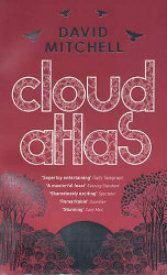
Cloud Atlas

David Mitchell's Cloud Atlas was another travel find:  the apartment building where we stayed in Berlin last June was located next to a cafe/bookstore.  My daughters and I spent a couple of happy afternoons browsing the books then drinking tea at the tables outside.  This place, called Buchkantine, had books in both German and English, and Cloud Atlas caught my eye because I've been a David Mitchell fan since reading The Thousand Autumns of Jacob de Zoet last December.  It's really nice to pick up and read a book purchased while traveling--like extending the trip a little.

Cloud Atlas is a series of memoirs, told by various people, in various literary genres, from various time periods in the past, present, and future.  Each tale is connected to the next in some coincidental way, and each is interrupted but picked up and finished later in the book.  Big themes such as reincarnation, voracious consumerism, and humans' desire for power, are explored.  The importance of choosing between good and evil, in large and small ways, comes up again and again.

Each is done in a different literary genre or style.  These include a 19th-century ship passenger's diary, a series of letters from a young wastrel in 1930s Europe to his lover, a thriller set in 1970s California, a contemporary narration of a British publisher's misadventures in a nursing home, and a dystopian tale set in future Korea.  The core story is set in post-apocalyptic Hawaii, and seems to represent a possible outcome of humanity's eternal quest for power and domination;  after this story, each of the others is picked up again in turn and finished.  

I enjoyed this book tremendously, because of Mitchell's skill.  Every character's voice, and every memoir's literary style, is absolutely unique and superbly executed.  The two stories set in the future really need some knowledge of history to understand all the references (a Korean character in the future calls a piece of furniture "il-jongian" the way we would call a sofa "victorian").  I love that.  Oh, and a Soul in the same tale is the term used, without irony, to refer to a credit card implanted in one's body.  The British publisher's misadventures had me laughing out loud (he refers to his fellow nursing home patients as the Undead).  The charming but selfish music student in 1931 Europe has a wonderfully waspish/vulnerable way of speaking which put me in mind of a lot of 1930s English fiction.

It's the kind of book you want to keep going back through to compare early passages with later ones, to catch nuances you missed the first time, to make connections that occur to you late in the book.  So glad I picked this one up in Berlin.

Chunkster Challenge

Friday, August 30, 2013

Wrap-Up: Language Freak Summer Challenge

Well, I have to thank Ekaterina at In My Book for a really enjoyable challenge.  It came at the perfect time for me, as I'm trying to improve my German by reading.  The challenge was to read as many books as we could in a language in which we are not fluent by the end of the summer.

I read Harry Potter und der Stein der Weisen and Anne Frank's Tagebuch.  (Those reviews, auf Deutsch, are here and here.)  I hadn't read Harry Potter before, but it was an easy read and good practice for me.  And I acquired some fun vocabulary--dragon, goblin, monster, troll, etc.  Anne Frank's diary was much more difficult, but I had read it in English years ago, so that helped.

Ekaterina encouraged us to write our reviews in the foreign language, too, which intimidated me, as I haven't written anything in German since college.  But I did it, with a lot of sweat and effort, and much consulting of online dictionaries, lol.  I also enjoyed very much connecting with a couple of other students of German and reading their work.  And I got some helpful comments on the Harry Potter review from a native speaker, which was wonderful. 

Looking forward to next summer's Language Freak challenge...

Saturday, August 24, 2013

From The Ruins Of Empire

From The Ruins Of Empire by Pankaj Mishra was purchased in, of all places, a bookstore in King's Cross Station in London, where we had gone to see Platform 9 and 3/4.  While the kids were taking each other's pictures, I wandered into the bookstore and was attracted by this nifty cover. 

Basically, it's a look at the Victorian era through the eyes of some of its victims:  the Asians.  The Victorian era, which is generally thought of in the west as a time of expansion, invention, and progress, was experienced by Asians as the dismissal and devastation of their ancient societies.  What many westerners don't know is that this juggernaut of change triggered intellectual movements in various Asian societies.  Asia experienced a cultural renaissance forged by some of these thinkers who attempted to form responses to the financial, cultural, and military onslaught of the Europeans.  Pankaj Mishra focuses on three such people:  the Persian Jamal al-Din al-Afghani, Liang Qichao of China, and the Indian Rabindrinath Tagore. 

Al-Afghani was an early espouser of pan-Islamism (Muslims uniting culturally and politically against European occupiers).  Al-Afghani used Islam to attempt to unify the people of Muslim countries, without much material success.  But he influenced such later figures as Saad Zaghlul, who led a nationalist movement against the British after WWI, the Salafis, an (unlike Al-Afghani) puritanical and Arab-centric sect, and Rashid Rida, who inspired the founders of the Muslim Brotherhood. 

Liang Qichao thought regretfully that China's traditional Confucianist culture was not ruthless enough to succeed in the cutthroat new world made by the Europeans.  China needed a "benign despot" to unite the Chinese people in order to better resist the onslaughts of the British.  He found republican democracy too chaotic and too vulnerable to incompetency to be successful.  His heirs were the New Culture movement, made up of young intellectuals, factory workers, and clerks who despaired of preserving old ways and wanted to completely remake Chinese society in Europe's ruthless image.

The section on Rabindranath Tagore was a revelation to me:  I knew him only as the author of beautiful spiritual poetry.  Tagore wrote and traveled tirelessly, trying to inspire Asians to hold on to the "moral and spiritual power" of their traditions against the exploitations of Eurpeans, and trying to find common ground with Americans.  He wrote a novel called The Home and the World (reviewed at Howling Frog Books!) dealing with the tension between old and new worlds in India.  Near the end of his life in the 1930s, he was appalled by the violent and militaristic trends in Asia, particularly Japan. 

As a look at a period of history through the eyes of the underdogs, this book is a lot like Howard Zinn's A People's History of the United States, which is US history as experienced by women, minorities, and the poor.  Both books should be required reading for high school, or at least college, students. 

Wednesday, August 21, 2013

Tagebuch

Ich habe Anne Franks Tagebuch auf Englisch gelesen, vor dreissig Jahre, als Teenager.  Dieses Mal lernte ich mehr uber die Geschichte der Zusammenstellung des veroffentliches Buches.  Auch, weil ich dieses Mal als eine Mutter das Buch gelesen haben, war meine Perspektive verschieden--ich merkte, und war ergrifft von, verschiedene Dinge.

Erst lernte ich, dass Anne das Tagebuch selbst uberarbeitet.  Im Radio hat sie gehort, dass nach dem Krieg, Uberlebenders Darstellungen wurde begehrt sein.  Sie schrieb fruher Textstellen um, um mehr interessant zu klingen.  Auch schrieb sie Textstellen dazu, in spater Eintragen.  (I know there's something wrong with that sentence;  I just don't know what.  Help?)

Annes Vater, Otto Frank, hat auch das Tagebuch herausgegeben.  Er strich Textstellen uber Annes sexuelle Gedanken und Gefuhle, ihre Gedanken uber die Natur ihrer Elterns Ehe, und andere.   (In spater Ausgaben des Tagebuches, haben diese Textstellen nachgestellt sein.) 

Was fallt mir auf, in dieses zweites Lesen?  Erst, naturlich, Annes Beziehung mit ihrer Mutter.  Annes Einstellung schaut mir jetzt sehr extrem an;  sie erklart sich unabhangig ihrer Eltern;  ihre Mutter ist "keine Mutter"!  Sie hat "keine Eltern;"  sie musst "selbst aufziehen!"  Der alleiniger Beweggrund, dass ich finden kann, ist dass ihre Mutter ist "Taktlos," und hanselt Anne.  Bestimmt, die Franks verstand nicht Annes Stress, und wahrscheinlich wahrnimmt ihr kommen in Pubertat nicht--uberhaupt, warum setzen Dussels Bett in Annes Zimmer?  Vielleicht findet sie Erleichterung vom Stress in extremer verbaler Ausserungen.

Auch findet ich Annes kleine Liebesaffare mit Peter sehr egreifend.  Es war so ruhrend, und so typisch, Annes wachsend Gefuhle fur Peter--sie weisst, dass Peter schluchtern und weniger intelligent als sie selbst ist, und in normaler Leben wurde sie ihm nicht interessant finden.  Aber sie fuhlt einen Mix aus Mitleid und Kameradschaft, und beginnt seine blaue Augen zu merken.  Und die Beiden wurde innerhalb Monaten tot sein.  Es bricht mir das Herz. 

As always, corrections from German speakers are appreciated--I know there's lots to improve here.  Also:  can anyone tell me how to get umlauts in Blogger?

Language Freak Summer Challenge