
Saturday, November 23, 2013
Selected Stories by Stefan Zweig


Middlemarch

Two characters' stories get the most thorough treatment, and they seem almost to be male and female foils of each other. Dorothea Brooke is an idealistic but naive young woman of good family, and Tertius Lydgate is Middlemarch's new doctor, ambitious to break new scientific ground in a research hospital. They share some obvious similarities--both are careless of others' opinion of them, and filled with a desire to improve the world. Both also make disastrous marriages which thwart their ambitions to do great good. But one ultimately finds a satisfying outlet for those ambitions, while the other settles for a severely limited horizon.
What I couldn't quite get a handle on with Middlemarch, was the book's attitude toward women. The author/narrator frequently makes asides on the weakness of women and the submissiveness of ideal wives. I read these as tongue-in-cheek, coming from a female author. And Dorothea has an interest in architecture--she draws plans herself for cottages for the poor. But no positively portrayed female character, even Dorothea, seems to have, or want to have, opinions or interests or desires other than their husbands'. They regard it as their highest good to subordinate their very thoughts to his, and their duty to suppress any thoughts or desires which conflict with his. The only character to not only think, but act, contrary to her husband's wishes is the monstrously selfish Rosamond.
But perhaps we shouldn't expect perfect consistency from authors. Certainly the psychological insights of this author toward her characters in general are wonderful and one of the great pleasures of reading Middlemarch.
Mount TBR Challenge
Chunkster Challenge
Classics Club
Wednesday, November 6, 2013
The Small Hand and Dolly

Saturday, November 2, 2013
Anna Karenina

Anna Karenina tells parallel stories about two couples, or rather, a triangle and a couple: Anna, her husband, and her lover; and Kitty (Anna's sister-in-law), and her husband Levin. Anna's sterile marriage and disastrous adulterous relationship are contrasted with Kitty and Levin's marital and spiritual growth.
Tolstoy really does do a remarkable job of getting inside characters' minds--men, women, and children. I caught myself wondering if he had asked his wife, for instance, exactly what it's like, physically and emotionally, to struggle with breastfeeding. He seems to understand the mental exhaustion of a mother with many young children and an irresponsible husband. And this is a man, writing in the 1870s! He captures the stress and frustration of an introvert forced to spend large amounts of time with argumentative people. He takes us inside the minds of all three members of the triangle--and I couldn't imagine any of them acting in any other way than they did. Their choices all seemed inevitable outcomes of their personalities. Even Anna's young son, the victim and onlooker, is fully realized.
Spiritual struggle is a major theme in Anna, as it was in War and Peace. From this angle, too, I felt the skill of the characterization. Levin is the character I would have expected to wrestle with questions such as the meaning of life and the existence of God. His development from agnostic to believing Christian is treated in depth, and doesn't feel like prosletyzing. Again, I wondered if Tolstoy was remembering his own experience, as it seemed to unfold so naturally.
Was Leo Tolstoy a warm, wise, and understanding man? There's no way to know for sure, of course, but that's how I think of him now.
Classics Club
Chunkster Challenge
Mount TBR Challenge
Tuesday, October 15, 2013
The Grapes of Wrath

Anyway. Now I love it too, and better late than never, I suppose. It's the story of the Joad family of Sallisaw, Oklahoma, whose farm is repossessed during the Depression. They take to the road, hoping to find work picking fruit in California. My two strong takeaways from this book are the very moving characterizations, and Steinbeck's apparent desire to get a social message across--the crying need for social safety nets such as unions and government programs.
Surely it's a sign of skillful characterization that I actually grew to love this family and suffered along with them through all their trials. They were by no means angelic; they were more interesting than that. Ma Joad's iron will is tempered occasionally by self doubt. Tough son Tom's quick temper is balanced by his integrity and passion for justice. Ex-preacher Casy, who has given up Christianity, eventually performs an act of self-sacrifice that is obviously meant to be Christ-like. I felt I was on a journey with these complex and interesting human beings, and was sorry to part with them at the end.
It's clear that Steinbeck was pro-union, and it's really hard to dispute, reading this book, the need for migrant workers to have some bargaining power when they faced starvation wages, squalid living conditions, and blacklisting by large farm corporations if they objected. I think it's easy to forget that within living memory, without government safety nets, Americans sometimes starved to death. (James, the blogger mentioned above, made this point in his review last year also. It's such a large theme in the novel that I don't know how anyone reading it could fail to be struck by it, and I certainly was.)
After finishing The Grapes of Wrath, I watched Ken Burns' documentary Dust Bowl. I'd highly, highly recommend that as a companion to this book. It provides a detailed but accessible explanation of the "dust bowl" phenomenon and its origins--a man-made ecological disaster. And it includes plenty of photographs, which I was constantly mentally matching to characters in the book. I also watched the 1940 movie starring Henry Fonda. Although the film is a truncated version of the book, and left out some important but controversial-for-the-time elements, the casting was genius and the acting superb. Watch it too.
Mount TBR Challenge
Chunkster Challenge
Classics Club
Tuesday, September 17, 2013
The Random Number Survey

I saw this meme over at Howling Frog Books (it was originally created by Melissa at Harley Bear Books), and it looks like fun, so I think I'll play. Here's how it works:
1. Pick a number.2. Go to your bookshelf and count that many books until you reach your number. Answer the question with that book.
3. Count the same number of books from where you left off and answer the next question.
4. Repeat until you finish the survey
I chose the number 10, and found every tenth book from my biggest literature bookcase. (I don't know why the spacing is wonky below, and I can't seem to fix it, sorry!)

1. Sense and Sensibility by Jane Austen: What do you think of the cover?
I love this cover. Many of my classic literature covers have paintings from the relevant period, and this one is well chosen. The slimmer, more erect girl on the left is obviously sober Elinor, and the lounging, plumper, tousle-curled girl on the right is emotional Marianne.

2. The Book of Sand and Shakespeare's Memory by Jorge Luis Borges: Write a review in 140 characters or less.
Two dreamy, hypnotic, fascinating, inventive story collections from late in Borges' life.
 3. The Lady With the Dog and Other Stories by Anton Chekhov: How or where did you get this book? I got it from Amazon, because I wanted to read "The Black Monk," which
is one of the stories in this collection. I was a little disappointed
because I thought it would be a creepy/gothic type of thing, but it was
more about madness, which I should have known given the author.
3. The Lady With the Dog and Other Stories by Anton Chekhov: How or where did you get this book? I got it from Amazon, because I wanted to read "The Black Monk," which
is one of the stories in this collection. I was a little disappointed
because I thought it would be a creepy/gothic type of thing, but it was
more about madness, which I should have known given the author. 
4. Great Expectations by Charles Dickens: Who's your favorite character in this book, and why?
Joe Gargery. He has such sweetness and dignity, and no pride or resentment.

5. The Adventures and Memoirs of Sherlock Holmes by Sir Arthur Conan Doyle: Recommend this book to a fellow blogger you think would like it.
Actually, this kind of stumps me. I've never seen Sherlock Holmes books reviewed on a blog, nor detective fiction, on the blogs I mostly frequent.

Probably three or four years ago, I don't remember exactly. It was a used-bookstore find, a thriller with a postwar Sarajevo setting that appealed to me.

I read this book in high school (!) which is so long ago that I barely remember it. Only one scene remains in my memory, so it must be my favorite--the childbirth scene, with Catherine having dreadful pains and sucking on the "gas" that they gave to laboring women at the time. It terrified me.

"She had--an expression. Happy. You don't see people look happy, just plain happy, do you? They look worried, they look worn down, they're frowning, or maybe laughing out loud... but this was--just happy. I remember it."

The Houston Museum of Fine Arts has a book club of sorts. They announce a book on their website, you read it, and then go in for a tour, which they have tailored to the book. This book is about a painter in postwar Japan, and the tour included a lot of Japanese art, with a docent-led discussion of both the art and the book.

I'd make it more like the cover of the book that I have, which is not the one shown. The one I have is a Wordsworth Edition, Strange Tales series. it has what looks like a pencil drawing called "Death shakes the dead leaves" by Robert Mathias. A skeleton is hanging on to a tree, a wind is blowing, leaves are flying, and both tree and skeleton are bowed. It's eerie and fabulous.

The title story in this collection is the only one I've read, and it has two characters--a man and a dog. I'd have to say the man is my least favorite character, because he makes some really bad decisions.

If you like magical realism, Spanish literature, or explorations of the dark side of human nature, you should try this book.

What I like about the edition I have (pictured) is that it's one of the set of Nemirovsky's books published in Britain by Vintage. The US-published ones look different. I found this one in a used bookstore. They all have the title in that swirly font, and a swoony period photo. I love them.

The dystopian future, and good Lord, no.

It's not specifically dedicated to anyone, but it has this rather moving paragraph before page one: "This book is to be neither an accusation nor a confession, and least of all an adventure, for death is not an adventure for those who stand face to face with it. It will simply try to tell of a generation of men who, even though they may have escaped shells, were destroyed by the war."
Wednesday, September 11, 2013
Cloud Atlas


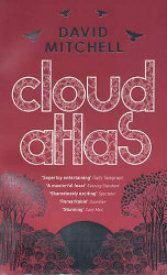
Cloud Atlas is a series of memoirs, told by various people, in various literary genres, from various time periods in the past, present, and future. Each tale is connected to the next in some coincidental way, and each is interrupted but picked up and finished later in the book. Big themes such as reincarnation, voracious consumerism, and humans' desire for power, are explored. The importance of choosing between good and evil, in large and small ways, comes up again and again.
Each is done in a different literary genre or style. These include a 19th-century ship passenger's diary, a series of letters from a young wastrel in 1930s Europe to his lover, a thriller set in 1970s California, a contemporary narration of a British publisher's misadventures in a nursing home, and a dystopian tale set in future Korea. The core story is set in post-apocalyptic Hawaii, and seems to represent a possible outcome of humanity's eternal quest for power and domination; after this story, each of the others is picked up again in turn and finished.
I enjoyed this book tremendously, because of Mitchell's skill. Every character's voice, and every memoir's literary style, is absolutely unique and superbly executed. The two stories set in the future really need some knowledge of history to understand all the references (a Korean character in the future calls a piece of furniture "il-jongian" the way we would call a sofa "victorian"). I love that. Oh, and a Soul in the same tale is the term used, without irony, to refer to a credit card implanted in one's body. The British publisher's misadventures had me laughing out loud (he refers to his fellow nursing home patients as the Undead). The charming but selfish music student in 1931 Europe has a wonderfully waspish/vulnerable way of speaking which put me in mind of a lot of 1930s English fiction.
It's the kind of book you want to keep going back through to compare early passages with later ones, to catch nuances you missed the first time, to make connections that occur to you late in the book. So glad I picked this one up in Berlin.
Chunkster Challenge
Subscribe to:
Posts (Atom)